Food insecurity impacts us all, and it will take every tool in our toolbox to solve hunger.
Across the Carolinas, there are neighbors in every county facing food insecurity. 1 in 6 Carolinians are food insecure, but we believe this estimate is actually much higher. As our member Food Banks strive to meet the growing need, we know that we cannot meet the need alone. For every meal our Food Banks provide the Supplemental Nutrition Assistance Program (SNAP) provides 9.
Our network of Food Banks strives to make sure folks are fed, whether they are providing the meal or encouraging policies that put more nutritious foods in the hands of families in need. SNAP is a critical tool that helps feed so many families in deeply vulnerable times of their lives. But, don’t take our word for it. Cicely and Brenna, part of the extended FTC family, share their personal experience, wisdom and insight on how SNAP helps families daily.
Cicely, Food Banks of the Albemarle

Cicely Wyatt, 44, is a single mother of five and the sole provider for her family in North Carolina. Even with a full-time job, she has relied on SNAP during difficult periods, a supplement that has made a meaningful difference for her household. “Not having to stress about food, or how you’re going to feed your kids… it’s a big deal,” she says. “SNAP is more of a supplement, to make sure you’ve got food for the whole month.” For Cicely, that support isn’t just about groceries — it’s about time. “SNAP has made it easier to have more free time with my kids,” she adds.
Like most SNAP participants who can work, Cicely does work — full time, as a customer service representative at the Food Bank of the Albemarle, where she helps agency partners like food pantries and meal programs get food out to the community. But even with steady employment, supporting five children on one income is a stretch: according to MIT’s Living Wage Calculator, a household her size would need an hourly wage north of to be self-sufficient without any public or private assistance. That gap is why Cicely sees the hunger-relief system differently than most. Her job puts her on both sides of it — she helps distribute food through the food bank, and she also receives SNAP benefits herself.
That dual vantage point has given her a firsthand understanding of how the two systems work together, not in place of one another. “As a recipient of SNAP and also a person who uses the food bank as well, you get to see it from both sides,” she says. “Not only am I helping get food to people, but I also benefit from that too.”
Cicely’s story reflects a broader reality for many working families: food assistance and federal nutrition programs like SNAP are not supplemental conveniences but essential pillars of family nutrition. Together, they help working parents close the gap between wages and basic living expenses, ensuring children and families have reliable access to the healthy food they need to lead active, healthy lives.
Brenna, Golden Harvest Food Bank
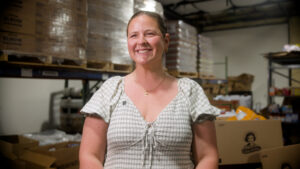
As a storyteller with Golden Harvest Food Bank, a Feeding America partner food bank, Brenna Johnson spends much of her time listening to the experiences of individuals and families across the communities the food bank serves. Again and again, she hears stories that challenge common assumptions about who experiences hunger. “It’s the stories you would least expect,” Brenna said. “It’s the people that you would least expect. These are just normal people.” Through those conversations, she has seen how SNAP helps families navigate rising food costs and everyday expenses, often serving as a bridge during difficult seasons.
While the average SNAP benefit—about $6 per person per day—doesn’t fully cover a family’s food needs, it still makes a meaningful difference by helping families stretch their resources further. “Most of the SNAP recipients, it is extremely important,” she said. “It’s that lifeline for them.” Her perspective reflects a reality she encounters often in her work: Hunger can affect anyone. The neighbors she meets are working, raising families, caring for loved ones and doing their best to move forward.
For many households, SNAP helps fill the gap between paychecks and grocery bills, providing support when rising food costs outpace household budgets. As Brenna has seen through the stories she helps tell, that support can make a meaningful difference for families working to make ends meet. “It’s the extra push,” she said, “to help them get to the next paycheck.”